Friday, May 04, 2018

Firearms - one more dip into the data

I've been looking at the data and graphics at the excellent "Graphical Representations" blog.  While there are many things there worth spending some time staring at, I was particularly interested in his post graphics matter, international edition which uses data from the international small arms survey to correlate gun ownership with murder rate in nations.

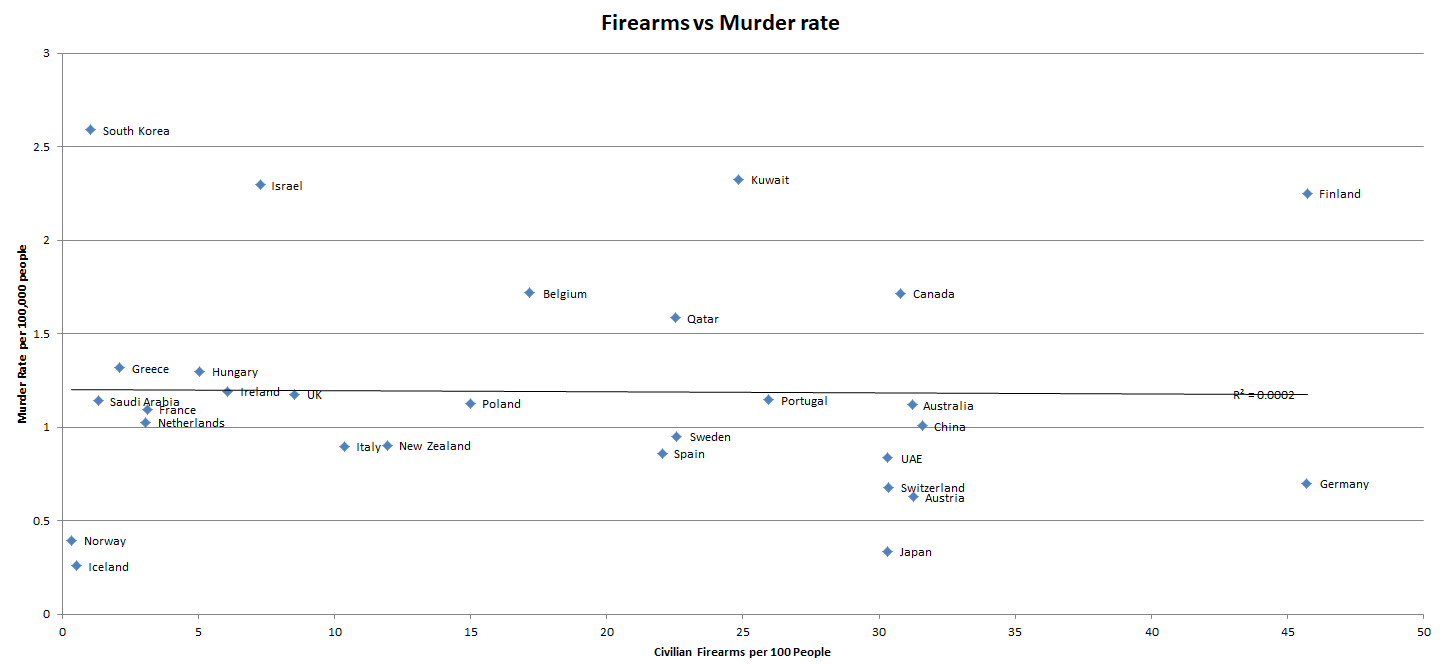
Here's his resulting chart with trend line.  (You'll want to click on it to see it larger, really you will, or go to the blog post above.)


Now, I have a problem with that chart, because it compares apples to kiwi to marshmallows. It includes developed nations with excellent police systems and legislatures and nations that are practically failed states, nations with active drug cartels and revolutionaries killing people.

But, he always links to his data, so I thought: "Lets restrict it to developed nations without international or civil wars going on in them, who aren't hosting pirates or drug cartels and have actual economies, albeit some are better than others... 

And I excluded the US.  I'm interested in the idea if in the rest of the developed world there is a correlation between civilian gun ownership and murder rates. 

I freely admit that the list of nations I chose out of his is prejudiced and entirely arbitrary.  Tough. My blog, my graph, go make your own.

Here's mine. 


R2 = -0.0002  I.E. the line is flat, there's no correlation.

Hmmmm.   And - as always - Show your work

Monday, August 18, 2014

A Difficult Admission

Since joining the 1632 team when first invited by Eric back in 2001, I've had fantasies of being an SF writer. To an extent that I never thought would happen, those fantasies have come true. I have published SF fiction in hardcover anthologies from a major publisher. I receive regular (small) royalty checks, I present popular crowded presentations at SF conventions, my publisher sends me Christmas cards and invites me to authors dinners. I've moved from outside looking in to inside looking out.

But in the past thirteen years, I've discovered something very surprising about myself. I am not, in any normal sense, a fiction writer. When presented with a character and a setting, when presented with the potential for a story, when I need to answer "what comes next?" my mind goes blank. The longest sustained fictional setting I have managed just barely scraped past 5000 words, and that very nearly tore my mind apart.

On the other hand, I'm quite a good writer, fast and prolific. I can produce 5000 words of text in a short single sitting, and can turn that out day after day without stress. I just can't do first or third person fiction that way. My special gift is elsewhere.

If you look back over the posts on this site, if you look at my published work in the 1632 universe, if you visit any of the Weird Tech sessions at the 1632 minicons, you will figure it out for yourself. I'm very good at explaining complicated things in a way that is both interesting an understandable. I'm not Carl Sagan or Neil Tyson, or Issac Asimov, or frankly any of the people listed in the appropriate Wikipedia article. Still, I'm pretty good.

What I can frequently manage, that those folks don't even try, is explaining science fiction from the inside. What are the limits and potentials of a slower-than-light multi-stellar civilization? What happens to radio in a time travel story to the 17th century? How do you make records in the 17th century? What is the likely social impact and the biological effect of the English War Unicorn on 21st century warfare?

Wood Hughs took the three part radio FAQ for 1632 and produced Turn your Radio On. Gorg Huff and Paula Goodlett took the non-fiction piece on record production I wrote with Chris Penycarte and gave us Trommler Records.

We've published a lot of non-fiction in the Gazette over the years.  Some of it, including most of Iver Cooper's work is essentially reference work, pieces that establish a basis for people who need a fact or a tidbit for the universe. Some, and I think most of mine, on the other hand are written from within the universe. They are non-fiction, but further the story by setting up the characters and the mechanisms that happen. What they lack, and why we publish those as non-fiction is that they don't have plots, they don't have character development. That doesn't mean they can't be entertaining. See Father Nick and Brother Johann's piece on fluidic computing.

In the future, I plan to put some of my original non-1632 pieces here. Sometimes (as in the case of those English war-unicorns) I get a universe, and sometimes characters and vignettes dumped on me. I've struggled for years to drag them into stories in short or long form. Sadly, it just doesn't happen, and there appears not to be a market for universe building.

On the other hand.  If there are any of you who have universes of your own, and who would like to let someone else play in it and to explain things, anyone who would like to have the numbers run, the t's dotted and the i's crossed for your story universe, let me know. If there's a place in an anthology or a place for an addenda to a novel or a novella, if you're not the sort of author who thinks that explaining things takes away the wonder, then have I got a deal for you!

Rick Boatright -- SF Universe popularizer for hire -- cheap.

Meanwhile, back to the trenches. There's a whole lot of complicated things out there that folks don't understand, and apparently it's my job to fix that. :-)

-_ Rick

Saturday, March 15, 2014

Yet another fisking of John Scalzi and Toni Weisskopf

Recently, Toni Weisskopf the publisher at Baen Books wrote a guest post at Sarah A. Hoyt's blog, a re-post of an essay she posted on Baen's Bar, a forum that requires registration so Sarah's repost is the public link.  http://bit.ly/1d2EKUl

This post has had a lot of responses ranging from acclaim to hate. That means that in some sense, it's important.  IMHO, the most interesting response was by John Scalzi in his blog: http://bit.ly/1nt40aC   It's that post I want to try to comment on.  I choose to do it here rather than in the comments there because there's a zillion comments on it already, and I'm writing to my friends, not his readers.

Scalzi summarizes Toni's post as follows:
“Once upon a time all the fractious lands of science fiction fandom were joined together, and worshiped at the altar of Heinlein. But in these fallen times, lo do many refuse to worship Heinlein, preferring instead their false idols and evil ways."
Let me make myself perfectly clear. Of all the styles of argument that you can engage in, this sort of straw man argument pisses me off.  It offends me. It makes me want to stand up and scream. The problem is, John's failed both at the art of summary and at intellectual honesty.  He's set up a target that he claims is Toni's work, and then shoots at it, but if you're going to try to tear apart a writer's work, it's important to actually tear apart what they wrote.  John didn't do that.  He exclusively comments, at length on his summary, not on what Toni wrote, never citing her words or thoughts. This is unjust and unfair.  As I said, it pisses me off.

What Toni said was:
"The latest fooforaws in the science fiction world have served to highlight the vast cultural divide we are seeing in the greater American culture. SF, as always, very much reflects that greater culture."   
She then goes on to enumerate the nature of the divide that concerns her. -- It's possible to draw many many different divides, but Toni is focusing on one, that traditionally fandom, and even more specifically fandom in the form of science fiction conventions traditionally has __nothing__ to do with greater world politics. The rule for more than seventy years has been "leave your politics at the door" -- that fandom was an open culture.

The problem is, in any group there are those who have a profound interest in the thing the group is about -- science fiction, pomeranians, geneology, whatever -- and there are those who have a profound interest in THE ORGANIZATION, WorldCon, The Pomeranian Society, the geneology club, whatever.  For a shorthand, call these people bureaucrats.

Lately, the bureaucrats have been pushing people out of SF groups, including SFWA, conventions, etc. based on their politics or even worse, the political leanings of the characters they write about. The bureaucrats are closing the open culture of SF and attempting to define "right thinking."

Toni then uses the example of Heinlein fans.  It didn't /need/ to be RAH, it could be almost anything. Specifically, she says:
"For instance, a slur that has been cast at people who dare criticize the politically correct, self-appointed guardians of … everything, apparently, is that they read Heinlein."  But please note later in the very same paragraph she says: "...these days is that you can watch Game of Thrones and Star Wars and anime and never pick up a book. And there’s enough published material out there that it is entirely possible to have zero points of contact between members of that smaller subset of SF readers."
Toni then asks the critical question about those who criticize the people who want to exclude them from SF groups and from conventions.
"So the question arises—why bother to engage these people at all? They are not of us. They do not share our values, they do not share our culture.
And I’m not sure there is a good enough argument for engaging them...."
John jumps on that. As a matter of fact, basically all of his essay pivots around that last sentence. He asserts that Toni is calling for Heinlein fans to be acclaimed as the "true" SF fandom to the exclusion of others.  The problem is, that's exactly the opposite of what she wrote.  Toni continued:
"There is only the evidence of history, which is that science fiction thrives on interaction. Artists, readers, authors, editors, all united in discussing the things that are cool and wonderful, together. "
Thus the divide.  In the rest of her essay, Toni gives further examples of this divide and further examples of why it is hard to bridge. In short, it's very difficult to have a conversation with others when you share no common experience and even harder when you, and those with like views are excluded.  John closes with a statement that both minimizes Toni's concerns and once again accuses her of refusing to participate in the larger SF community:
If the Baen folks do, in fact, decide to contract into a little defensive ball in which only the pure of heart shall be admitted into Bob’s sight, the impact on the rest of the science fiction and fantasy field will be pretty much exactly nothing. The rest of the field will chug along in its myriad ways, happy not to be bothered by a small and shrinking group yelling at them you aren’t the true fans, no not at all, why aren’t you listening to us. 
Baen and its fans and writers are what any of us in the genre are: a constituent part, something the makes the whole greater than the sum of the parts. It’s a shame so many of the people who identify with it — the publisher included — appear to be yelling at the rising tide of the current field to keep it from coming in. I imagine that Robert Heinlein might have something pungent to say to them about it. Maybe he already did. I’ll have to check the notebooks.
The problem, once again is that John's shooting at his straw-man.  Toni's conclusion is directly opposed to the idea of "contracting into a little defensive ball:"
And I think again SF is mirroring the greater American culture. Our country is different because it, like science fiction fandom, was built around an idea—not geographic or linguistic accident, but an idea—we hold these truths to be self evident. And it is becoming more and more obvious that the two sides of American culture no longer share a frame of reference, no points of contact, no agreement on the meaning of the core ideas.
And yet, I can’t help but think that at some point, you have to fight or you will have lost the war. The fight itself is worth it, if only because honorable competition and conflict leads to creativity, without which we, science fiction, as a unique phenomenon, die.
 So.  Scalzi says if Toni and the Baen readers go away, no one will notice, and that we should not worry about what they have to say.  Toni says that suddenly, in a change from tradition, SF is excluding people based on what they think, and that SF traditionally thrives on conflict, and that because of that, those who are being excluded should fight to stay.

Yep.  Straw man.  Damn John, I respected you for a long time.  Why John Scalsi, why?

Me,  I just checked to make sure I had made my hotel reservation for Libertycon.

Wednesday, September 04, 2013

Chicago Police Chief says his cops will shoot legal concealed carry licensees

In which I once again prove I am not a lawyer, and never-the-less try to analyse something a Chief of Police said.    -- and yes, he said that.

No, really.

Ok, well, sort of, and yes, really.    More after the jump.


Wednesday, May 29, 2013

Gun deaths, Automobile deaths and Josh Sugarmann's attempt to manipulate you.

Once again Josh Sugarmann has jumped into the gun debate in the U.S. feet first with a Huffington Post essay entitled: Guns Kill More People Than Motor Vehicles in 12 States & DC.

Once again Josh says: "The road to reducing gun death and injury is clear and well marked, if only we would choose to take it."  By that he means a short list of things.  Ban semi-automatic guns. Ban almost all handguns. Enact universal registration so that later, the bans can be enforced against pre-existing guns. This pattern is well known, and well understood and is the path that has been followed in the U.K. and in Australia. He, and his ilk, contend that by leaving you single shot long guns and double-barreled long guns, they would respect the 2nd amendment, since they're letting you keep some arms.  Many of us would beg to disagree.

There are, of course, several problems, the first with his statistics. Josh gives us a list of thirteen jurisdictions where the number of gun deaths exceeds the number of auto deaths:
  • Alaska: 144 gun deaths, 71 motor vehicle deaths
  • Arizona: 931 gun deaths, 795 motor vehicle deaths
  • Colorado: 555 gun deaths, 487 motor vehicle deaths
  • District of Columbia: 99 gun deaths, 38 motor vehicle deaths
  • Illinois: 1,064 gun deaths, 1,042 motor vehicle deaths
  • Louisiana: 864 gun deaths, 722 motor vehicle deaths
  • Maryland: 538 gun deaths, 514 motor vehicle deaths
  • Michigan: 1,076 gun deaths, 1,063 motor vehicle deaths
  • Nevada: 395 gun deaths, 289 motor vehicle deaths
  • Oregon: 458 gun deaths, 324 motor vehicle deaths
  • Utah: 314 gun deaths, 274 motor vehicle deaths
  • Virginia: 875 gun deaths, 728 motor vehicle deaths
  • Washington: 609 gun deaths, 554 motor vehicle deaths
Which looks horrible, except you need to remember something we've discussed before. Two-thirds of firearms related deaths are suicides. Massively restricting firearms as in the UK or Australia, or even for all practical purposes eliminating firearms does nothing to reduce the suicide rate.  The UK's suicide rate increased after the handgun ban. Australia's suicide rate stayed stable and then increased after the semi-auto and handgun ban, and Japan, which for all-practical-purposes has a total firearms ban for civilians, has a much higher suicide rate than the U.S. 

The thing is, it's very rare for someone to kill themselves using a car.  It does happen, but it's uncommon. Guns are more efficient, neater and less likely to harm a bystander. After guns strangulation, drowning, and medication overdoses are common. 

Take out the 2/3 of the gun deaths that are suicides and you get a very different picture... 
  • AK  48 / 71
  • AR  310 / 795
  • CO  185 / 487
  • DC  33 / 38
  • IL  355 / 1042
  • LA  288 / 722
  • MD  179 / 514
  • MI  359 / 1063
  • NV  132 / 289
  • OR  153 / 324
  • UT  105 / 274
  • VA  292 / 728
  • WA  203 / 544
DC appears to be an outlier in this set, but there's an explanation even for that, a really simple explanation.

Two thirds of automobile fatalities occur in rural settings.  No one really knows why, but according to the 2001 National Highway Traffic Safety Administration (NHTSA) traffic safety statistics, 61% of traffic fatalities occurred in rural areas even though rural areas account for only 40% of the vehicle miles traveled and 21% of the population. This is even true in other countries.  

DC doesn't have any rural.  

To go further, we would need to compare the percentage of population that is urban vs rural in the state along with the ratio to population of gun ownership in order to know if we can make any further conclusions on that front, but DC being an outlier makes perfect sense in this regard. 

Additionally, non-suicide gun deaths tend profoundly urban.  Overall gun death rates are similar in rural and urban environments, but how they occur are different. Homicides by gun are much more prevalent in urban areas per 100,000 people but suicide by gun is much more prevalent in rural areas per 100,000 people, so when you take out the suicides, the gun death's tend urban. (Reference Link)

So, were are we on Josh Sugarmann's  "oh the horror, oh the humanity" that gun deaths exceed car deaths in 13 jurisdictions?  

Uhmmmm, it doesn't hold. 

Josh also makes a big deal about the fact that auto-deaths have fallen over the last decade, and how gun deaths have not. Let's remember a few points we've gone over before. Most gun deaths are suicides. After you take out suicides, you are left with gun crime and accidental death. None of the proposals (background checks, registration, etc.) short of confiscation will reduce gun crime, and the Australian experience suggests that even confiscation doesn't help. So, let's look at accidental gun deaths:  Each year in the last decade, the number of guns in the US has increased between five and ten million per year.  Despite that the number of accidental handgun deaths in the U.S. has fallen from 130 in 1999 to 91 in 2010, a 30% decrease. (Reference) During that same time, according to Josh's graph, automobile deaths fell 17%. 

Here's the executive summary: 
  • Other car deaths are related mostly to rural driving. Other than suicide, gun deaths are related to Urban areas. 
  • None of Josh Sugarmann's or the Violence Policy Center's proposals for gun control would do anything to improve the ratio above.
  • The rate of accidental gun deaths is falling faster than the rate of accidental automobile deaths.
And that's about enough for tonight. 

Wednesday, May 15, 2013

The Mosin-Nagant - Thoughts, Deals, investment, care, cleaning and etc.

This blog post was inspired by a recent spate of postings on facebook and a comment thread at "The Truth about Guns" on my favorite center fire rifle, the Mosin-Nagant. The M91 Mosin action was first put into service in 1891, and 19th century Mosin receivers are still in use by the Finnish military as the basis for sniper rifles. Along with the British SMLE (short magazine Lee Enfield) which dates from 1895 and the Mauser '98 which (obviously) dates from 1998, the Mosin-Nagant is one of the few military arms with more than a century of being in official service. (Yes, the 1911 just passed that gate, along with Browning's other masterpiece the M2 50 caliber machine gun.)  Since the Finns have actually used receivers from the 1890's in some of their Tkiv 85's, those may arguably be the oldest firearms in active military service in the world.

Anyway, the spate of facebook postings, and the comment thread on TTAG gave me an excuse to put all my thinking and experience with Mosins in one place triggered by this happy annoucement:

Classic Arms has my favorite rifle in the world on sale just now in a neat special: http://www.classicfirearms.com/mosin-nagant-rfile-by-the-crate  $2500 for an unopened crate of Mosin's direct from Mother Russia (Ok, from the Ukraine) for $2500.

Friday, May 10, 2013

Guns are bad. Evil Evil guns. Thoughts on gun control part nine: Summary

I've been laying out the information and thinking that has shaped my position on firearms over the last decade, what changed in my mindset and what changed in my actions.  I had been planning for the last several months to finish this series with an essay tying it all up neatly.  I was trumped this week by a post by Barry Snell in the Iowa State Daily.   If you want to just skip all the rest of this and go read that, I'll understand.  Barry did a better job than I can, and honestly, I'm going to be pull-quoting a lot of it in this post.  Still, there's doubtless a benefit in writing my own summary, even if only to make sure I have this all straight in my mind.

Thursday, May 02, 2013

Thoughts on Gun Control - part eight. The Manchin-Toomey proposal. What went wrong?

The Manchin-Toomey proposal.  What went wrong? 

In other words, why didn't it pass?  The President, and VP Biden, and Emperor Bloomberg's mouthpiece organization Mayors Against Illegal Guns contend that the NRA and the Gun lobby (which they contend is the same thing) bought the votes to defeat M-T.  From where I sit it doesn't look that simple.  Let's walk through it a bit and see what went wrong:

Tuesday, April 16, 2013

Boston Marathon Bombing: Deriving some Physics and other info from video analysis

While the official investigations proceed, there is a ridiculous amount of speculation about the bombing, who did it, what it was, etc. Very little of this speculation is evidence based. Almost all of it is just blathering based on the beliefs or prejudices of the posters.
Instead, let's take a quick look at what we can know with certainty from the evidence we have.
The first thing we have to do is determine where the bombs went off. Fortunately, the New York Times provides an excellent infographic for that purpose:

Monday, April 15, 2013

Thoughts on the gun debate part seven: Treat guns like cars.

One of the frequent things I hear when discussing the gun control issue with many people is the proposal that we treat guns like cars. Recently, Michael Z. Williamson took a turn at that idea that I want to build on a bit. Let's visit that guns/cars equivalency. Let's turn it around for a moment. There are already rather a lot of gun laws out there which most folks who aren't "gun people" don't know about.  So, let's try the analogy in the other direction; as Mike asked the other day, how about we treat cars like guns?  Here's what would happen if we tried that.

Friday, April 12, 2013

Thoughts on the gun debate part six: A scholar's view of history.

This is going to be a short post. I want to call your attention to Steven Halbrook's lastest piece for the Fordham Law Review. He explores efforts to include a right to arms in their 1789 Declaration of the Rights of Man, and adoption of gun registration just in time for the Nazi occupation and gun confiscations.

The full article is available here. I'm going to cite (claiming fair use) a section from his conclusion.

Thursday, March 28, 2013

Comparing England (or UK) murder rates with the US: More complex than you thought

Thoughts on the Gun Debate part 4a -- wherein I fix my oopsie in regard to comparing US and English murder rates... Oooops. It turns out that I was wrong.

This post edited after comments were reviewed on 3/29/2013.  Edits from that date will be noted with an Edit tag. 

First, lets get this out of the way.  I'm not going to fuss here about the terms "England", "The U.K", "Great Britain", "The Olde Country" or "The folks with those classy accents who live on some islands off the coast of Europe."  I'll be careful to cite things in the links, but don't chew me up on where I'm talking about.

On to the oopsie. I have frequently in this series referred to the English murder rates as historically low and currently very low compared to US murder rates.  I blandly accepted the murder statistics published by the UK Home Office as definitive.  I overlooked the details of what and how the English counted "murders." It turns out that was a big mistake.  (I was first turned onto my error by this post at Extrano's Alley.)

I fell into a definitions trap you may not be aware of. The shortest version is this. We count and report crimes based on initial data. The Brits count and report crimes based on the outcome of the investigation and trial. Yep, that says what I meant it to say.

Wednesday, March 06, 2013

Thoughts on the gun debate part 4

So, quick re-cap. We know from the last several posts that banning handguns in England did nothing to effect the English murder rate, that the murder rate in the US has fallen since around 1990, that the suicide rate hasn't surged, and that in nations with strict gun control suicides still happen, sometimes at even higher rates than the US.

The other question that seems reasonable is about who has guns, where they are found and how they are used.  Specifically, I'm talking about concealed carry license holders.  Different states have different rules about concealed carry ranging from Vermont's "We don't need no stinking rules" to Hawaii's "We have the ability to issue a license, but that doesn't mean we're going to do it."

Sunday, March 03, 2013

Thoughts on the gun debate part 3

In the last rock, we looked at the murder rate in England after the gun bad following Dunblaine, and came up with "basically no effect."

That is to say, after the handgun ban went into effect in England, in January of '97, from then until 2003, the homicide rate went up from 11.5 per million to 18 per million.  I.E., in the six years following the handgun ban, the murder rate in England went up by 1.5.  Meanwhile, in the U.S, from 1990 to 2003, the murder rate fell from 9.8 to 5.5 per 100,000, despite the fact that during that time the number of handguns in the U.S. rose by more than 2 million.

From 2003 to 2011, the murder rate in England fell from 18 per M back to the 11.5 per M that it was at the time of the ban.   Meanwhile from 2003 to 2011 the murder rate in the US decreased at a slower rate, from 5.5 to 4.8 per 100K despite millions more guns making their way into the US population.

This suggests that at the very least, handguns don't by themselves drive the murder rate.

Thursday, February 28, 2013

Thoughts on the gun debate part 2

So, in the last installment, I had decided to try to figure out what my position in regard to gun ownership should be. What was right and proper?  Early on, it became clear that at various times in various places in this country all sorts of laws had been passed and enforced regarding all sorts of guns and all sorts of people.  A data-based approach to the question didn't seem to be served by spending a lot of time researching those laws or why they were passed or their constitutionality, or the legislative and judicial history of gun control in the U.S.. What I wanted to know was what the effect of the guns was.  What was the risk and reward?

Tuesday, February 26, 2013

Thoughts on the current gun debate.

No one changes their minds based on stuff posted on the intertubes, and anyone who reads this ever will already have had access to all this info, but I'm going to try to pull it together for my peace of mind.

The first 50 years of my life I owned no guns.  I didn't hunt, I didn't shoot.  I largely "protected" my kids from guns, and was of the opinion in general that guns are sufficiently dangerous that I don't need them around any more than I need a chainsaw or an dune buggy or a motorcycle.  Guns are dangerous hardware, and I just didn't want to go there.  Note that I also didn't play with chainsaws, dune buggies or motorcycles.  I'm a geek.  I sat at my computer, and was content.

However, around 2003 something changed.  Perhaps, as I became more and more exposed to the gun community, as I  hung out with the 1632 writers and fans, as I met and socialized with other Baen authors, I became somewhat more acculturated to guns.  They moved out of the motorcycle category into the circular saw category  something that is dangerous, sure but not so intrinsically dangerous that they can't be handled and used.

At about the same time, my political position shifted too.  I'll never be a right-wing-ideologue but the longer I was a partner in a small business, the more I was forced to deal with out-of-state business regulations and taxes, the more I interacted with my customers about the regulatory difficulties that they had running their business, the more I came to the position that MOST of the regulations that apply to small businesses in the US are trickle down regs resulting from bad actions of a few idiots, and of large impersonal businesses.  More and more I came to ask why the government was involved in regulating things that I didn't see a need for them to regulate, nor an authorization for them to in the US or state constitution.

Wednesday, November 14, 2012

Creating new homepage default widgets for vTiger


Create a new, custom "default widget" for the vtiger home page.  

We wanted to do this pretty badly. However, the vTiger documentation on the code sucks dead bunnies and the only post anywhere about how to do it was by someone whose native language was not english and who assumed "rather a lot" about the environment you were putting the modification into.


This post documents our process to get custom widgets running in vTiger 5.4.0. I make no guarantees that I didn't leave something out, but I tried by golly, and it's pretty good documentation as it sits. Good luck and happy programming!

-_ Rick

Saturday, October 06, 2012

Malicious Chrome Plugin.

I got bit.  :-/   I installed "Youtube Downloader." for what appeared to be a good and valid reason, really it was.

Then, today, when I was attempting to work on a page for a client, I saw a weird javascript in my source that started:

var hkghawgalkgklrgjlargjsrhg_hejrghakwghakwegkawefak = (function(){ var e=null,f=[[15,18,7,19,2,0,17,14,6,3,11,20,16,1,9,4,8,13,12,5,10],[19,1,16,5,14,17,13,18,15,8,2,20,7,11,4,9,12,10,3,6,0],...... (lots more) 

What's weird is that this was getting injected on a page that I had on my c: drive.


Wednesday, August 15, 2012

Harry Harrison died yesterday.

I'm getting really really tired of this sort of thing.

I'm really glad I keep meeting younger writers our I would have shelves full of nothing but dead people.

Wait.  That's happening anyway since I read all the younger writers in E form.

But still, you know what I mean.

But Harry Harrison?  DAMN.

I remember when Jim Henson died, and I thought... "Kermit the Frog died today."  Well, no, because as it turned out other people could write for that character.

On the other hand,  Slippery Jim died yesterday.  No one but Harry would ever be able to write that character.

Thursday, June 28, 2012

Ship It!

Kris Rusch once again jumps to the core of an issue indi writers face: When to ship.  It's a classic problem in every industry... the cliche is "rip it out of the engineers hands and ship it!"

No product, no story, no program, nothing made by humans is ever perfect.

Recently, I had a conversation with a mid-list writer friend who told me that he had a three novel fantasy series whos publisher had folded before the books ever came out, and he was thinking about going back and revising it before putting it up on Amazon because he was a much better writer now. I controlled myself mightily and did not hit him.  I explained clearly that he should ship it, and make more money by writing something else.

Read Kris's version here:  http://kriswrites.com/2012/06/27/the-business-rusch-perfection/